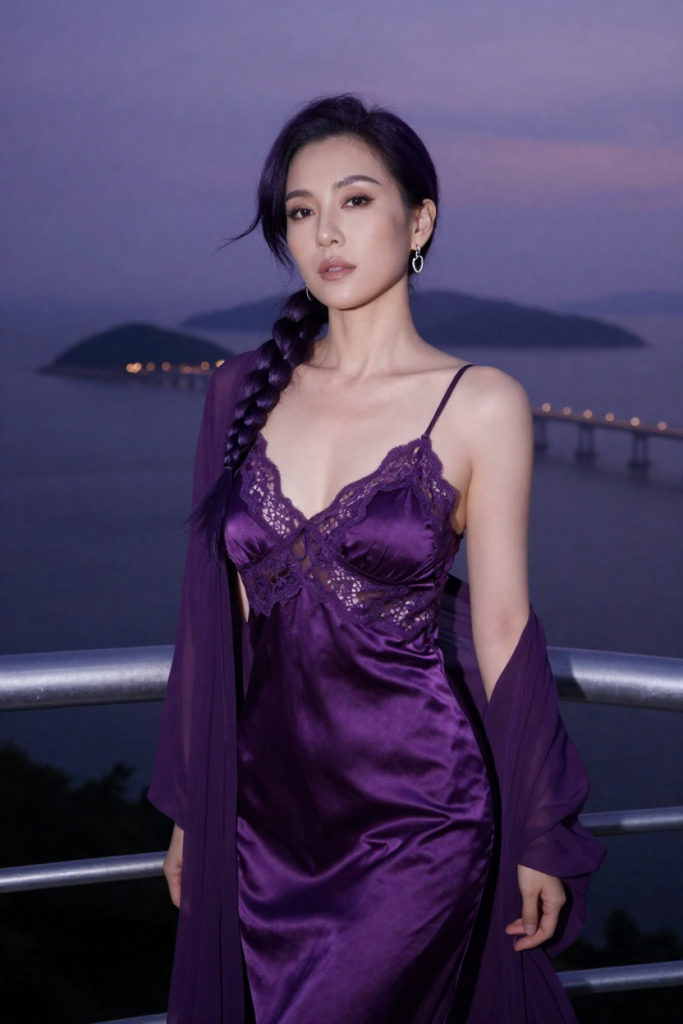
Series drift is usually blamed on the model. Watch the prompts instead. The muse is described from memory each time, and memory edits as it goes: “violet-black rope braid” in one month becomes “dark flowing hair” the next, and the audience watches a stranger take over the feed, one plausible frame at a time. The repair is clerical. Write the woman down once, in words you paste rather than retype, and treat that document as the first landing of every route you build with her.
Five anchors, in order
A working brief holds five things. Age — a number, always 25 or over. Hair — colour, length, one usual style, named as a construction rather than a compliment. Build — two or three words, no more. Face — one or two details that endure at a distance. Signature — the earring, the mole, the mark that survives a crop. Everything else is a scene line: outfit, place, light, pose. Scene lines are meant to change at every landing. Anchors are the links that must not.
Two habits keep a brief healthy. Anchors are stated plainly and positively — “a single rope braid over one shoulder” survives generation, while “beautiful hair” is re-interpreted at every attempt. And the brief is versioned. When the muse is deliberately changed — a new style, a new signature — the new text is saved as version two, with a date, so an older set can still be remade exactly as it was, link for link.
Working from it
Production then becomes a route rather than a gamble. Pair the brief with scene lines that share one place and one light, and make the set at the standard model’s 6-credit price. Keep the best third. Spend on repairs, swaps and upscales only after the cull. When a frame returns off muse, the cause is almost always visible on paper: a scene line contradicted an anchor, or an anchor was too vague to hold a crossing. Both are fixed in the document, not in settings.
What it cannot do
It cannot hold a woman who was never decided. If the anchors are adjectives — lovely, striking, perfect — no system will keep her linked. Decide her on paper first. The brief is not where the imagination happens. It is where the imagination is kept.